Skip to content
The Science

Light, translated.

Red light therapy works by stimulating mitochondrial activity at specific wavelengths, 630 nm, 660 nm, and 810 nm. But the output depends on what's sitting in your skin when the photons arrive. Most serums weren't designed for this. We formulate ours to be transparent in the therapeutic window and keyed to the substrates the pathway uses.

Last updated
April 2026
Read time
~8 min
01
Section · Wavelengths

Three wavelengths, three serums.

Each wavelength reaches a different layer of skin and does different biology there. We built a serum for each, so every layer the light hits has the right substrate to work with.

630nm
Red · surface
Depth · 1–2 mm · epidermal
  • Fibroblast stimulation
  • Collagen I synthesis
  • Tone + capillary circulation
Paired SEVO serumMorning
Sodium Ascorbyl Phosphate · 5% SNAP-8 · 5% Astaxanthin · Ferulic acid
660nm
Red · mid
Depth · 2–5 mm · papillary dermis
  • Peak CCO absorption
  • Anti-inflammatory cascade
  • Barrier + cellular repair
Paired SEVO serumEvening
GHK-Cu 1% Matrixyl 3000 · 5% PAL-150 · 5%
810nm
Near-infrared · deep
Depth · 5–10 mm · reticular dermis
  • Deep-tissue ATP
  • Collagen remodeling
  • Wound-healing signaling
Paired SEVO serumRadiance
Bakuchiol 1% CoQ10 · 2% Pterostilbene · 0.1%
02
Section · Protocol

The fifteen-minute routine.

Four steps, fifteen minutes. Cleanse, layer the serum that matches your session, run the panel, seal. Same every time.

T + 0 min · cleanse
01
Clear the canvas.

Oils and residue scatter photons at the surface before they reach the dermis. Clean, hydrated skin transmits light better.
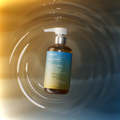
Purity Facial CleanserPurity Facial Cleanser
T + 2 min · AM layer
02
Morning, for daytime.

If this is your AM session: 3–4 drops of Morning. Surface antioxidants (ergothioneine, astaxanthin) sit at the epidermis where 630 nm does its work.
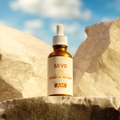
Morning SerumMorning
T + 2 min · PM layer
03
Evening, for repair.

If this is your PM session: 3–4 drops of Evening. Peptide co-factors (GHK-Cu, Matrixyl, PAL-150) feed the fibroblasts 660 nm activates in the papillary dermis.
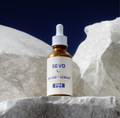
Evening SerumEvening
T + 3 min · light
04
Run the panel.

Device at the distance your manufacturer specs. 5–10 minutes. 630 + 660 + 810 nm hit the epidermis, reach fibroblasts, activate cytochrome c oxidase. Finish with Radiance or your night moisturizer to seal.
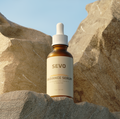
Radiance SerumRadiance
03
Section · Mechanism

Photobiomodulation, step by step.

If you want to go deeper: red and near-infrared photons are absorbed by cytochrome c oxidase in your mitochondria. Absorption triggers ATP production, controlled nitric-oxide release, and signaling-ROS bursts, the same pathway your skin uses to repair itself at night. The serum's job is to be transparent in that window and to supply the substrates the pathway needs.

i
Phase 01 · Priming

Clean skin, damp carrier.

Hydrated stratum corneum transmits photons more efficiently than dry skin. 3–4 drops of serum, patted in. Wait 60 seconds for the carrier to set before the panel turns on.

60 secAbsorption lead time
ii
Phase 02 · Activation

Light hits the mitochondria.

630–850 nm photons are absorbed by cytochrome c oxidase in the electron transport chain. ATP production increases, controlled ROS signaling kicks off, nitric oxide releases, the pathway your skin uses to repair itself.

~8 minTypical session dose
iii
Phase 03 · Compounding

Substrates feed the pathway.

The light activates the cellular machinery. The serum supplies what that machinery needs, peptide co-factors, ergothioneine for mitochondrial redox, CoQ10 for the ETC, NAD+ precursors for cellular energy metabolism. Barrier repair continues for hours after the panel turns off.

Weekly cadence for measurable response
On transparency, most SPFs, mineral pigments, and silicone gels are opaque at 630–660 nm and block the majority of therapeutic light. SEVO formulas avoid those ingredients by design. Oils and silicones heavy enough to scatter photons don't make the cut.
04
Section · The evidence

What the literature says.

Photobiomodulation is one of the best-studied non-pharmaceutical interventions in aesthetic dermatology. These are peer-reviewed studies we find most informative, linked so you can read them yourself, not selected for flattery.

+37%
Collagen density after 30 sessions
Wunsch + Matuschka · Photomed Laser Surg · 2014
wrinkle depth
Measurable reduction in periorbital wrinkle depth
Barolet D · Semin Cutan Med Surg · 2008
ATP
CCO activation → mitochondrial ATP output
Karu T · Photomed Laser Surg · 2010
2014
A controlled trial to determine the efficacy of red and near-infrared light treatment in patient satisfaction, reduction of fine lines, wrinkles, skin roughness, and intradermal collagen density increase.
Wunsch + Matuschka · Photomed Laser Surg · Vol 32
2008
Light-emitting diode (LED) in dermatology.
Barolet D · Semin Cutan Med Surg · Vol 27
2013
Mechanisms of low level light therapy.
Hamblin MR · Proc SPIE · Vol 6140
2018
Photobiomodulation in human skin: evidence and mechanisms of action.
Avci et al. · Semin Cutan Med Surg · Vol 32
Official panel partner · we use this ourselves

The panel we formulated around.

We formulated SEVO against a Chroma Radiance, professional-grade diodes at the three most-studied wavelengths and a modular tower format that fits in a bedroom. The panel we use every night is the panel we recommend. No affiliate revenue.

Wavelengths
630 · 660 · 810 nm
Build
Professional-grade diodes
Warranty
5 years
Trial
100 days
05
Section · Questions

Common questions.

01
How long until I see results?
Tone and luminosity shifts show up around week 2–3 for most people. Fine lines and texture change require a full dermal remodeling cycle, 8 to 12 weeks of consistent use is honest. Photograph skin at day 0, day 30, day 60 so you're measuring by evidence, not by memory.
02
Can I use retinoids with red light?
Not in the same session. Retinoids are photosensitizing and can amplify irritation under the panel. Radiance uses bakuchiol instead, a plant-based alternative with head-to-head research against retinol, and no photosensitivity. If you use a prescription retinoid, alternate nights.
03
Does SPF block red light?
Physical SPFs (zinc, titanium) block most therapeutic wavelengths, they're opaque at 630–660 nm. Chemical SPFs absorb UV but are largely transparent in the red spectrum. Either way, apply SPF after your session, not before.
04
Is it safe for sensitive skin or rosacea?
Generally yes, 660 nm has anti-inflammatory effects that can reduce rosacea-related erythema in the literature. Start conservatively: 5 minutes, 3× per week. Pair with Morning serum (gentle) rather than Radiance (bakuchiol) for the first 30 days.
05
Can you overdo it?
More isn't more. Above 20 minutes per session you enter diminishing returns, and at extreme doses biphasic inhibition, the signal that was helpful at 10 minutes becomes noise. The sweet spot across most studies is 8–10 minutes, 4–5× per week. Rest days matter.
06
Why does SEVO pair with red light better than other serums?
Two reasons. First, we avoid ingredients that scatter or absorb light in the therapeutic window, no heavy silicones, no mineral pigments, no opaque oils. Second, the actives we do include feed the pathway photobiomodulation opens: peptide co-factors for collagen synthesis, ergothioneine for mitochondrial redox, CoQ10 for the electron transport chain. The light activates the machinery; the substrates feed it.
Ready to begin

Stack the light. Keep the actives.

Take the quiz